The problem
Coop is a fictional grocery + delivery hybrid with 100,000 SKUs across its catalog.
There is no unified organization system. Every section of the store has its own way of categorizing products, and those categories overlap, compete, and contradict each other across departments.
60% of the catalog was tagged inconsistently, which meant that the same product could appear in three different categories depending on which team's system you were looking at.
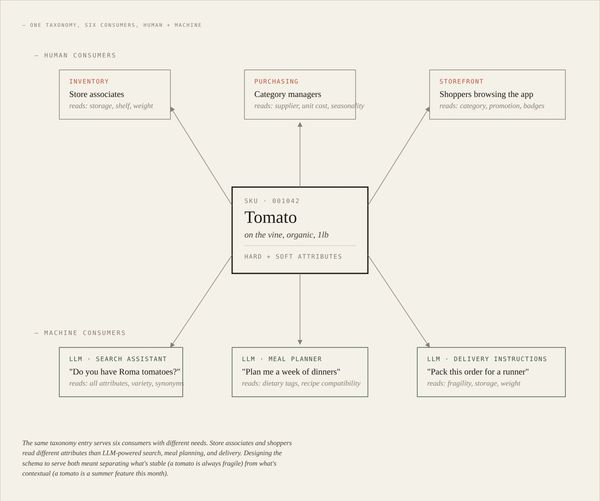
The taxonomy was consumed by at least six different systems: inventory, purchasing, the storefront, data reporting, the delivery app, and the meal planning tool. Every one of them was operating on a slightly different version of the truth.
To update a single product entry required buy-in from every department head who touched that category. Consensus took an average of six weeks per update. In a catalog of 100,000 items, at a company that adds and swaps products constantly, six weeks per change was not a workable pace.
On top of all that, Coop has LLM-powered features and needed clean, machine-readable taxonomy to work.

What I owned
I led the taxonomy overhaul as PM across ten cross-functional teams.
I Interviewed 6 department heads to map the territory.
Every team believed their categorization was the right one. Before proposing anything new, I needed to understand why each version existed and what it was optimizing for. Inventory cared about shelf placement. Marketing cared about promotional groupings. Delivery cared about handling requirements. Meal planning cared about recipe compatibility. All valid, none reconcilable in the legacy structure.
Designed a taxonomy that served humans and machines from the same source of truth.
The new structure needed to work for a store associate restocking shelves, a shopper browsing the app, a purchasing manager forecasting demand, and an LLM answering "what should I make for dinner tonight." That meant separating hard attribute from soft ones and letting the same product carry both without conflict.
Then I partnered with engineering to build a tool that made the taxonomy usable at scale. Manual tagging wasn't going to hold up across thousands of products and constant catalog churn, so we built a system that aligned every product to the taxonomy automatically and kept the alignment current as things changed. New products got classified on ingest. The taxonomy stopped being a document people had to remember and became infrastructure the catalog ran on.
Better search relevance for shoppers, cleaner data for the LLM, faster restocking for associates, and a purchasing team that could actually trust the numbers. One source of truth, kept true by the tool that fed it.

The outcomes
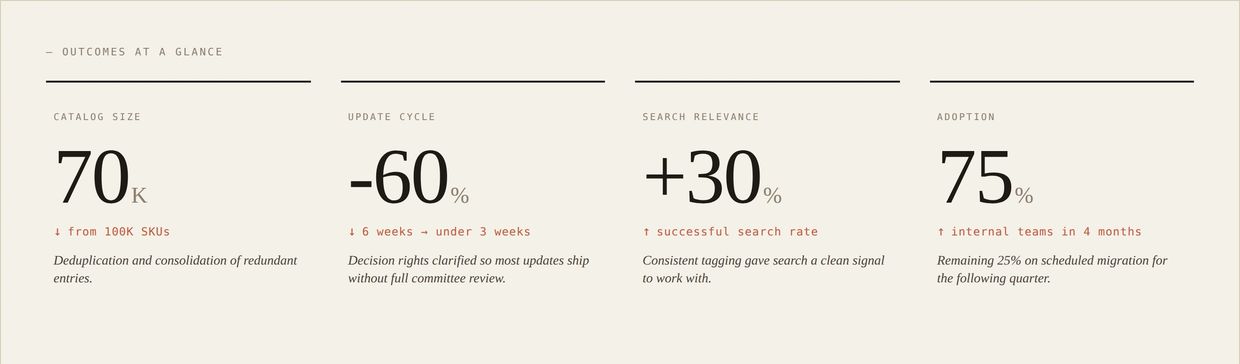
- Catalog reduced from 100,000 to 70,000 SKUs through deduplication and consolidation of redundant entries.
- Update time cut from 6 weeks to under 2 weeks (70% reduction) by clarifying decision rights and giving each team ownership of the axes they actually cared about through the tool.
- 30% improvement in successful search results on the storefront, driven by consistent tagging that gave the search engine clean signal to work with.
- The taxonomy also unblocks future AI features.
What this shows
Taxonomy work looks like plumbing until you realize how many downstream decisions depend on it. Getting it right is a communication and collaboration problem more than a technical one. Ten teams, ten opinions, one catalog that has to work for humans, associates, and AI features. Making that come together is the job.